Reflections on the sufferings of Blessed Carlo Acutis (2023)

Webmaster • November 8, 2026

Share this article

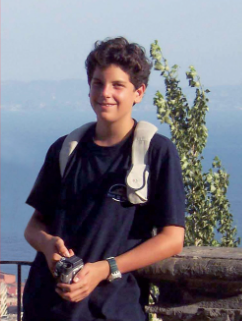
Suffering of Blessed Carlo Acutis


Limits of talk: personal reflection on some aspects of CA’s suffering on basis of my limited knowledge and understanding of him.


  1. His parents’ lack of faith: a “deprivation” in earliest years. God worked it to his advantage through the believing nannies that came his way.
  2. Perhaps the fact of no siblings? Again God used it.
  3. School life: suffering of his empathy and compassion, of the mockery he received, of standing up for the bullied, the harassed girls, the Church’s teaching, his purity and devotion to Jesus (my life program is always to be near Jesus).
  4. Socially: he felt deeply for the suffering of the poor and the immigrants.
  5. Spiritually: self-denial (non io ma Dio) in self-discipline and in consistency and perseverance in living out his own originality (non fotocopia).

CA clearly underwent a gradual process of realising how different he was from others, not so much in externals as internally. This will have led to a certain inner solitude, humanly speaking. He will have felt misunderstood by others but himself have understood this misunderstanding of him: he will have seen that because they did not have the kind of relationship with Jesus which he had, they would not be able to understand why he acted as he did.

When Christ draws someone closer to himself it always involves a process of detachment from others and from self – not a detachment from loving them, but from attaching to his love for them a greater importance than the love for Christ. This detachment is the way of the Cross: it leads to a turning upside down and inside out of the priorities we humans usually have. When Christ captures the heart, it means a total reassessment of our lives.

  1. In a way known only to Jesus and to Carlo, there must have occurred a critical point of no return. At some point, Carlo realised that he was no longer just to be like Christ for others here below, but to become Christ for others from heaven above. We can only really become Christ for others when we realise we are Christ’s alone. In some way, it reminds me of St. Paul who told the Philippians that he would rather be gone and be with Christ, but that he would probably remain alive in the flesh for their sakes. In another way, of course, it is also true that we can do more for others from heaven than we can do on this earth.

How do we know that Carlo realised that a point had been reached in his life in Jesus that pointed to an early death?

Carlo recorded a video message two or three months before he died in which he explicitly says “sono destinato a morire”: I am destined to die. He wasn’t talking about some date in many decades’ time, because he had already intimated to his mother that he would die young and the exact cause of his death. Christ’s taking of Carlo to himself interiorly translated exteriorly into Carlo’s passion, the physical suffering that would transform him into the crucified Jesus.

  1. I want to approach Carlo’s final suffering by drawing some parallels with the Passion of Jesus himself. Obviously, it is not Carlo, but only Jesus who saves us and equally obviously the passion of a redeemed sinner is only a faint reflection of Christ’s own passion.
  2. Jesus predicted his passion no less than three times, according to the Gospel. “The Son of man is destined to suffer grievously.” Carlo did the same: twice he told his mother and, when he went into hospital he told her again, “I will not be getting out of here.” Then there is his video message in which he uses the word “destined”, to die.
  3. Jesus predicted with certainty how he would die, by crucifixion. Carlo told his mother that he would die of a brain haemorrhage.
  4. Jesus accepted his death in humble obedience to the Father. Carlo accepted his destiny in a similar way. There’s no protest in the video, but serenity and simplicity. Submission to a higher Will.
  5. Both Jesus and Carlo were young, good people, with, as we would say in our all too human fashion, “with their life ahead of them.” Incident in Assisi last week of young father who expressed sorrow that Carlo had died so young).
  6. Jesus describes his death as the grain of wheat that falls to the ground and dies and yields a rich harvest. The grain of wheat can easily be read as the Eucharist, which is the bread of life because the Lord died. Carlo’s faith in the Eucharist and deep and sustained love for and reception of it conformed him to Christ the Grain of Wheat. Carlo has died, and just look how rich already is the harvest he is yielding by Christ’s power.
  7. Jesus’ sufferings deformed him over night: “He seemed no longer human.” Carlo’s mother writes movingly and poignantly about her horror in seeing Carlo’s physical deterioration in the course of the short period he was in hospital. Looks are no match for the barbaric reality of our mortality.
  8. Jesus offered no resistance and made no complaints, but trusted to God. When the women of Jerusalem wept for him, His response was to deflect and reflect their compassion back upon them. When Carlo was asked about his pain in leukemia, he responded that there were many who suffered more than he. And when the nurse asked him if she should wake his mother to come to him in his final hour, he said to leave her alone, since she was very tired and would only worry more.
  9. Paul tells us that Christ sacrificed himself so that the Church would be spotless and holy. Carlo offered his sufferings explicitly for the Church and for the Pope, that is for the Mystical Body of the same Lord who sacramental body he loved so dearly.
  10. Christ poured out his last drop of blood for our salvation. Carlo’s death was not so bloody, yet it was a brain haemorrhage which took him in the end.
  11. Carlo died on a Thursday, the Day of the Eucharist. But Thursday contains the Friday, the Cross and the Sunday, the resurrection.
  12. An obvious difference between Christ and Carlo is that Christ’s tomb is empty. Carlo’s is yet to be emptied. That it will be emptied one fine day is the basic and certain hope we all have because of Christ. And Carlo knew it. He knew that from heaven he would be able to send signs to his mother. May be what he didn’t realise was the Christ would be sending him to bring so much hope and consolation to so many from one end of this broken world to the other, even to wee places like Fairlie, Skelmorlie, Millport and Largs.
  13. We all love Carlo’s phrase, “non io ma Dio”, not I but God. Now, “io” is IN “Dio”: i.e. who I am is in God’s great I AM. My story can only have meaning to the degree that it is IN God’s story. There is no other story. The story of every saint and of every human being who lives authentically is God’s story of love being told over and over again. That’s especially true of our suffering, as Blessed Carlo has shown us. He joins that immense army of men and women from across the ages who now stand before the Lamb who was slain. May it please the Lord, through Blessed Carlo’s intercession, to join us to them when our highway to heaven reaches its destination.             Fr. Peter, 13.10.23


Recent Posts

By Webmaster • November 27, 2026
This annual event will take place on Saturday 28 November in the monastery tearoom from 1.15pm to 4pm. Entrance fee £3, children free. Come along and enjoy a fun afternoon, with Raffle, Tombola, Fancy Goods, Knitwear, Baking, and Jewellery stalls. Donat ion of Prizes and Bottles
By Webmaster • November 27, 2026
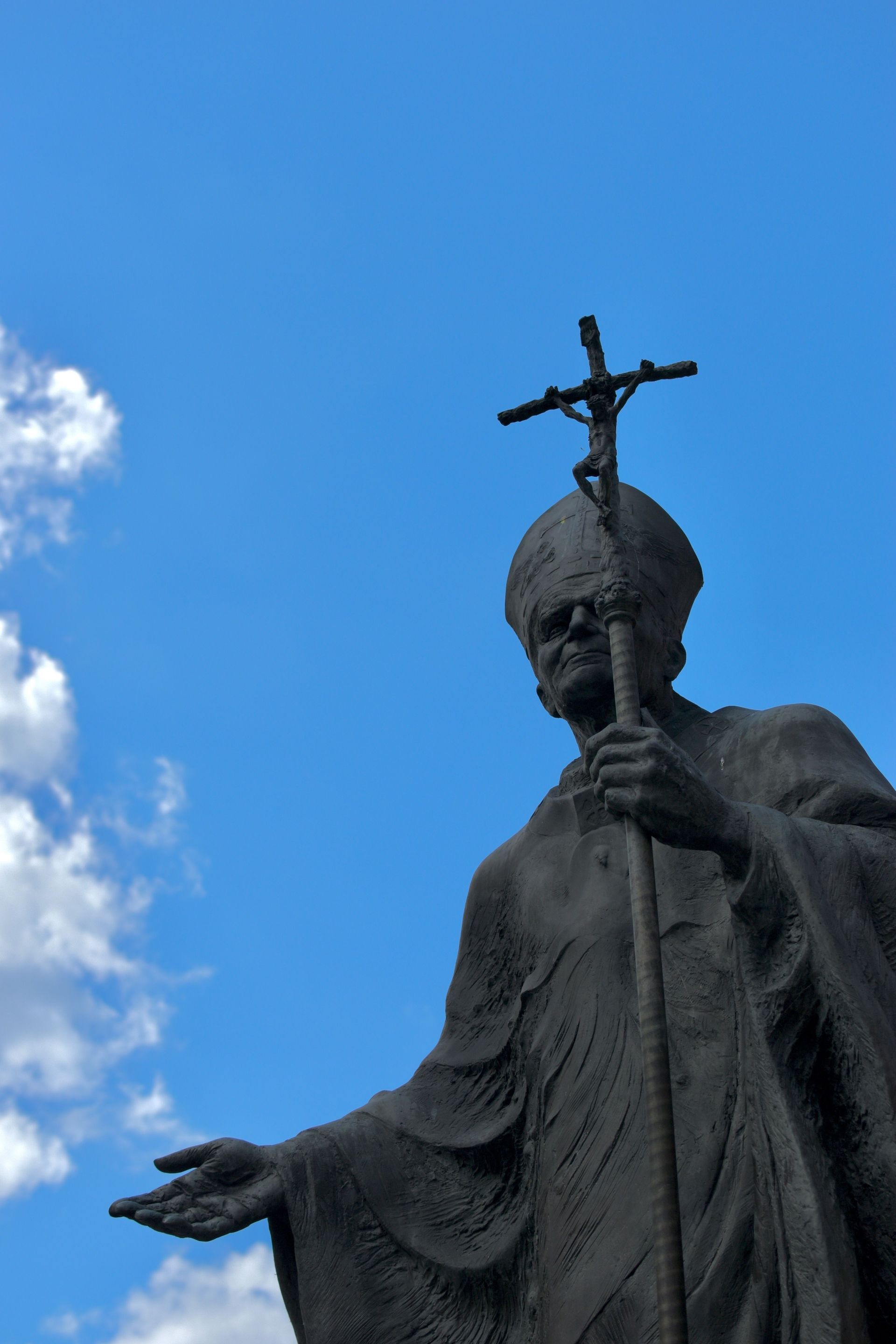
Important excerpts from Pope Leo XIV
By Webmaster • November 27, 2026
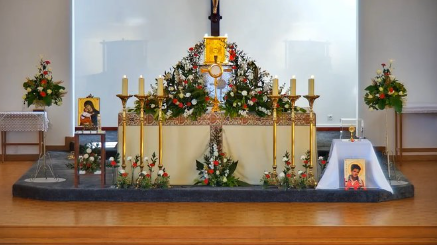
ADVENT: As we all know, Advent gets swallowed up in the commercialization of Christmas. The sales pitch pushes out the true spiritual depth of both Advent and Christmas. Still, I encourage everyone, myself included, to try and consider at least the period up to 17th December (when the pre-Christmas octave begins) as a penitential period. That’s what the Church teaches us. Hence the purple vestments, the absence of the Gloria and the call to fast and abstain. It’s about focusing on Christ’s return to judge the living and the dead and about preparing for that with a more intense prayer and sacramental life. Decide what penance you wish to make as you do in Lent. Reduce screen time, talk less, go to Mass more often, prepare to make a good confession before Christmas, do acts of charity, etc.. Let’s “redeem” Advent for the Lord!
By Webmaster • November 27, 2026
ADVENT SYCAMORE COURSE (St. Mary’s): “Exploring our Faith.” Two Wednesday evenings, Dec. 9th and 16th, 7pm to 8.30pm, in the Church Hall. Why not take some time out during ADVENT to meet other parishioners and explore/reflect on aspects of our faith? Just turn up on the day or add your name to the list in the Porch. It’s an open invitation and all are welcome. For any further information contact Gordon McMillan Tel. 07977-403462 gordonmcmillan7@gmail.com
By Webmaster • November 27, 2026
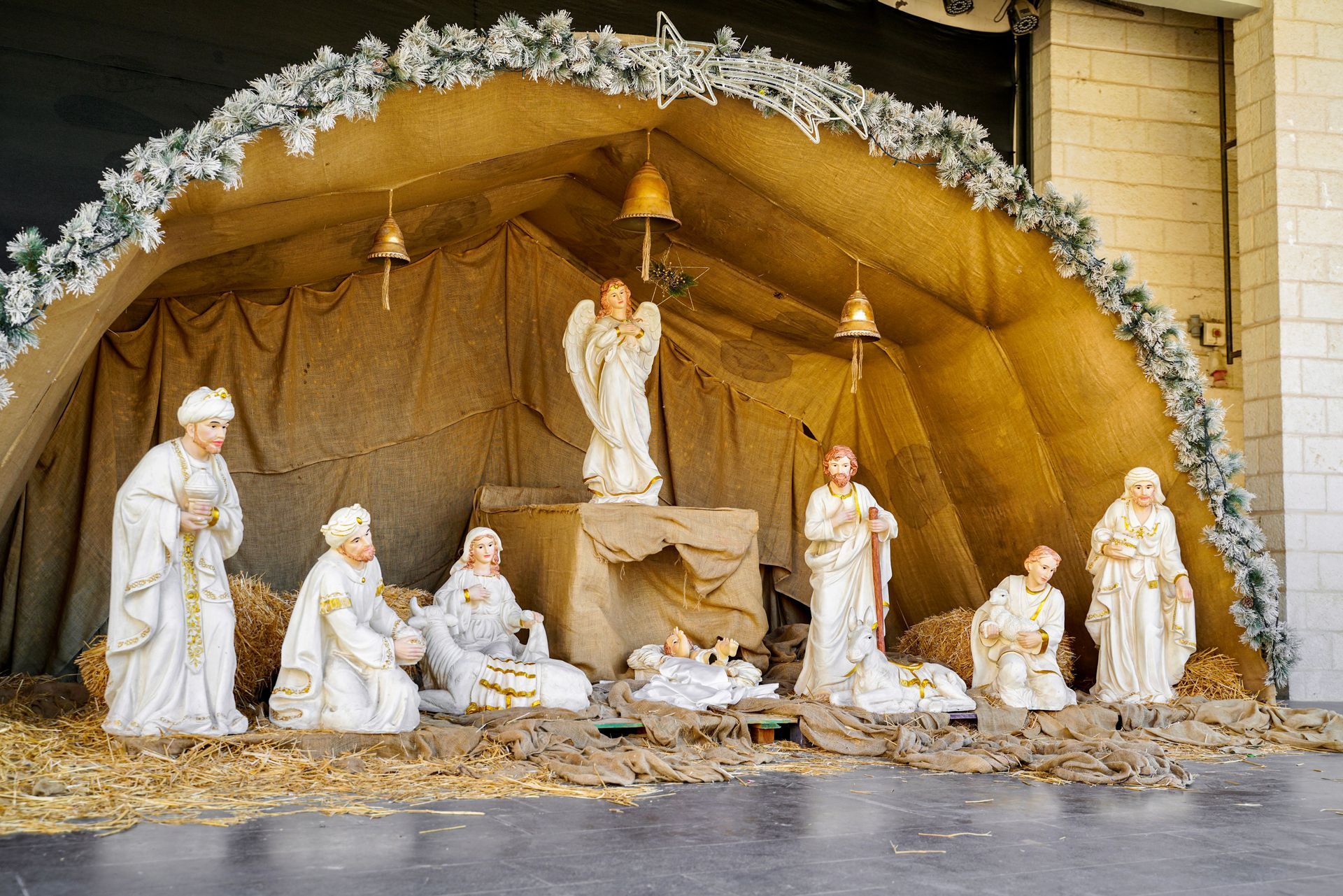
Further to our posting of the multiple choice quiz recently( details below). Please find the answers for those who wish to explore: ANSWERS TO THE MULTIPLE-CHOICE TEST ON “MY CATHOLIC FAITH' FAITH”: 1-a; 2-b; 3-b; 4-a; 5-d; 6-c; 7-b; 8-c; 9-a; 10-d; 11-a; 12-b; 13-c; 14- a; 15-d; 16-c; 17-false; 18-false; 19-true; 20-false; 21-c; 22-b; 23-b. Dear Parishioners You may have seen from last weekend’s bulletin, our intention to make available the multiple-choice test which I we to our RCIA candidates recently. Here is the test:
By Webmaster • November 27, 2026
ST. MARY’S PRIMARY NATIVITY PLAY: I am delighted that St. Mary’s parish can once again host the children and community of St. Mary’s Primary for their Nativity Play on Tuesday 8th December at 7pm in St. Mary’s Church. I warmly invite parishioners to come along and celebrate this beautiful event. It’s a lovely way to honour the Immaculate Conception of Our Lady which recurs precisely on the 8th December.
By Webmaster • November 27, 2026
STELLA MARIS CAROL CONCERT & BUFFET (St. Mary’s): This will be held on Thursday 17th December. The concert begins at 6pm and the buffet (in the hall) at approximately 7.15pm. Everyone is welcome to the concert but, if you wish to attend the buffet, you must sign your name on the list prepared at the back of the church. Please use a different line for each person and avoid bunching couples or groups in one line! This will ensure we get a clear idea of the numbers. There is a limited number of spaces, so please sign up soon if you wish to participate in the buffet
By Webmaster • November 27, 2026
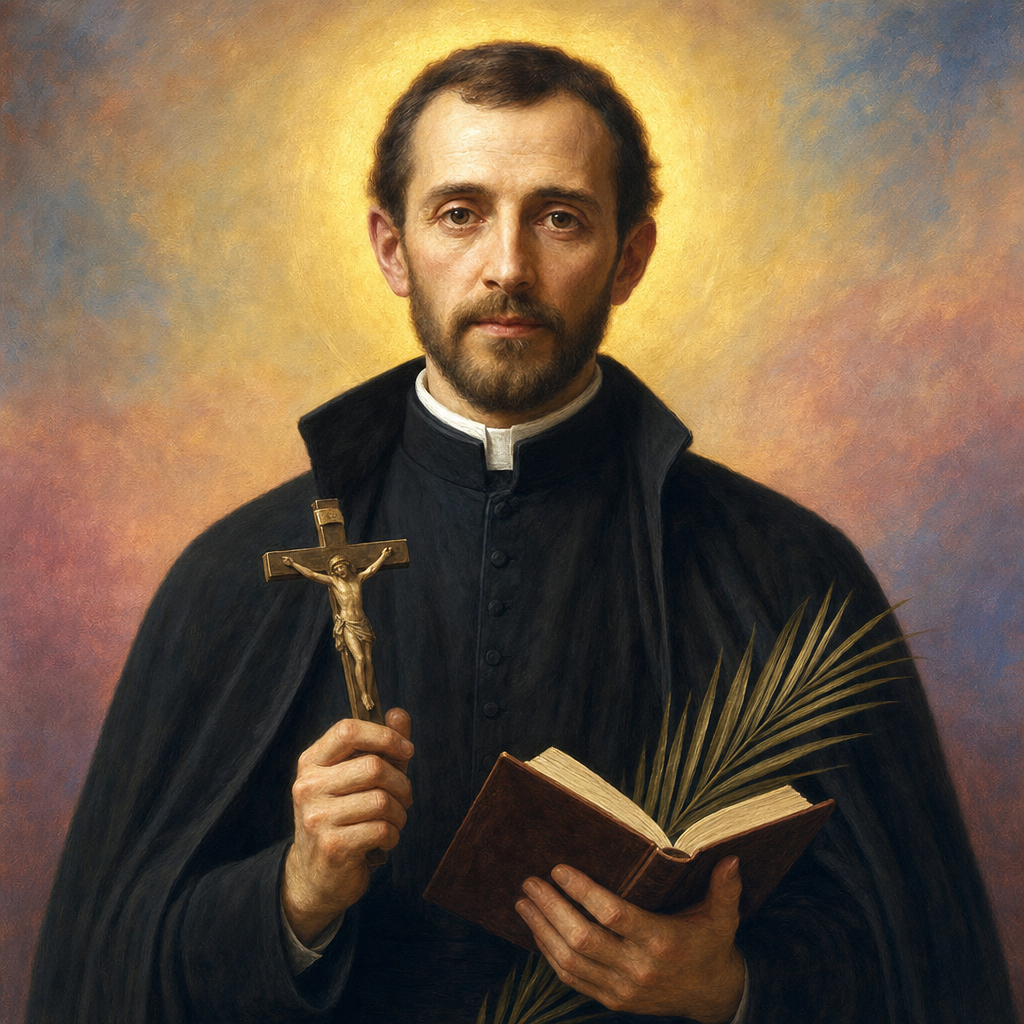
St Edmund Campion (1540-1581)  Edmund Campion was born in London on January 25, 1540, received his early education at Christ’s Hospital, and, as the best of the London scholars, was chosen aged thirteen to make the complimentary speech when Queen Mary visited the city. He then attended St John’s College, Oxford, becoming a fellow in 1557 and taking the Oath of Supremacy on the occasion of his degree in 1564. Two years later he welcomed Queen Elizabeth to the university, and won her lasting regard. He was chosen amongst the scholars to lead a public debate in front of the queen. People were now talking of Campion in terms of being a future Archbishop of Canterbury, in the newly established Church of England. Although holding Catholic doctrines, reinforced by his reading of the early Fathers, he received deacon’s orders in the Anglican Church. Inwardly “he took a remorse of conscience and detestation of mind.” Eventually he went to Douai where he was reconciled to the Catholic Church and received the Eucharist that he had denied himself for the last twelve years. The college was a centre of intellectual excellence and Campion found himself reunited with many of his former Oxford friends. His studies completed he left for Rome, travelling on foot and alone in the guise of a poor pilgrim. He then entered a novitiate with the Jesuits, and spent some years in Vienna and Prague. In 1580, the Jesuit mission to England began. Campion entered England in the guise of a jewel merchant, and at once began to preach. His presence soon became known to the authorities, not least because of the challenge he made, known as the “Challenge to the Privy Council” to his allies and as “Campion’s Brag” to his enemies. As a result his position became increasingly difficult. He led a hunted life, preaching and ministering to Catholics in Berkshire, Oxfordshire, Northamptonshire, and Lancashire. On his way to Norfolk, he stopped at Lyford, near Wantage, where he celebrated Mass and preached both on July 14 and on the following day. Here after a long search he was found in hiding above the gateway. He was taken to London with his arms pinioned and bearing on his hat a paper with the inscription, “Campion, the Seditious Jesuit.” Committed to the Tower of London, he was questioned in the presence (it is said) of Elizabeth, who asked him if he acknowledged her to be the true Queen of England. He replied in the affirmative, and she offered him wealth and dignities, but on condition of rejecting his Catholic faith, which he refused to do. He was kept a long time in prison, where he was twice racked, and every effort was made to shake his defiance. He took part in a number of public debates and reportedly conducted himself so easily and readily that he won the admiration of most of the audience. He was indicted at Westminster on a charge of having conspired, along with others, in Rome and Reims to ‘raise a sedition in the realm’ and dethrone the Queen. He was sentenced to death as a traitor. He answered: “In condemning us, you condemn all your own ancestors, all our ancient bishops and kings, all that was once the glory of England — the island of saints, and the most devoted child of the See of Peter.” After spending his last days in prayer he was led with two companions to Tyburn and hanged, drawn and quartered on December 1, 1581, aged 41. From Universalis
By Fr. Peter • November 24, 2026
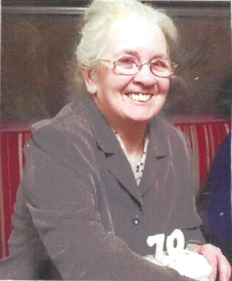
MRS. FRANCES ANN MALY, RIP (Millport): With real sadness, I inform parishioners of the recent death of Frances Maly on 14 th November, aged 80 years, at Woodland View Hospital, Irvine, fortified by the Rites of the Church. May the Lord grant her rest from all her labours and the crown of everlasting happiness in the Kingdom. Let us pray also for all the loved ones she has left behind that the Lord will comfort and console them with the Holy Spirit. The Requiem Mass for Frances will be held in the church of Our Lady of Perpetual Succour, Millport, on Tuesday 1 st December at 12.30pm, and thereafter to the Clyde Crematorium for 2.30pm.
By Webmaster • November 24, 2026
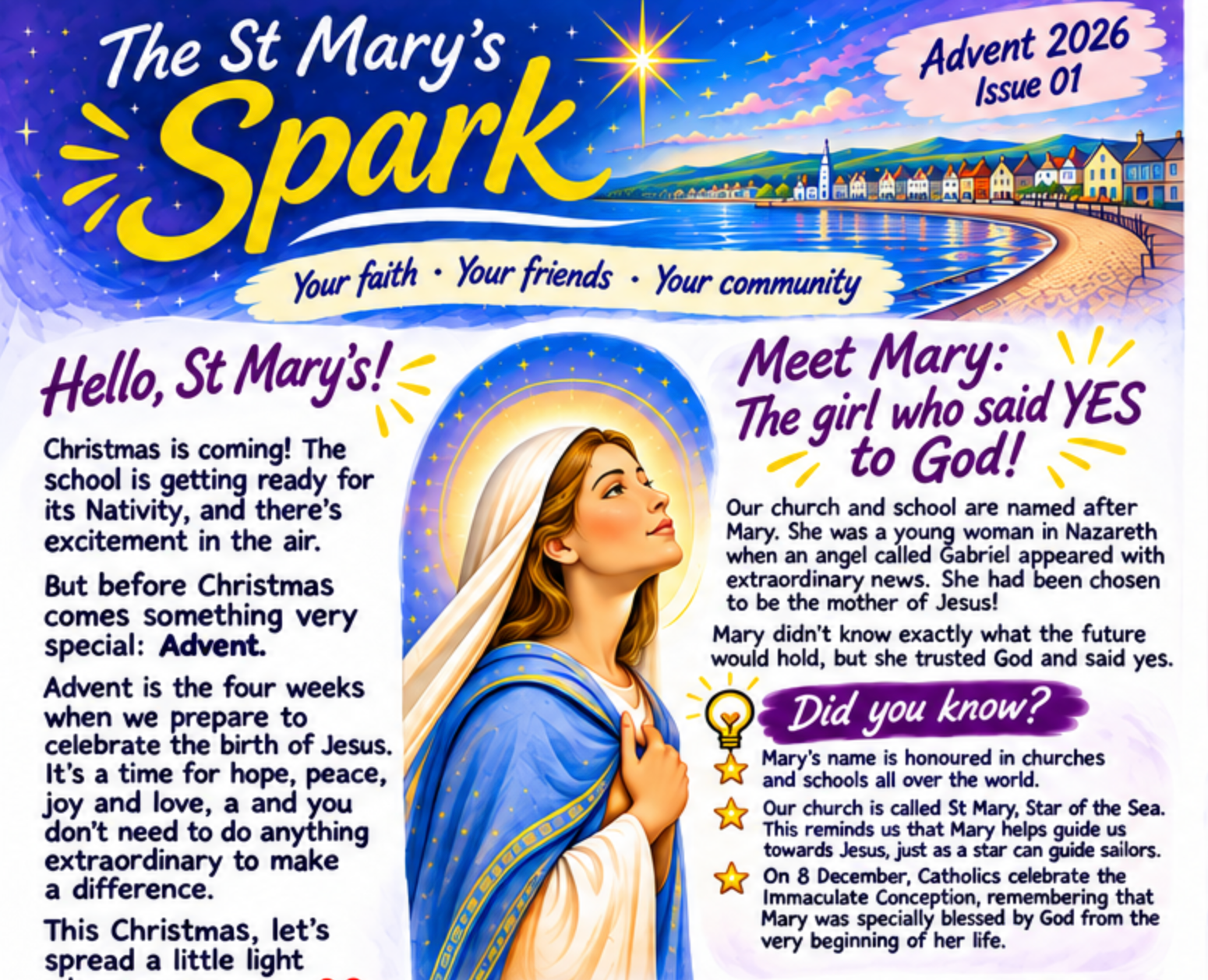
We are delighted to present the Advent edition of The St Mary’s Spark, our new quarterly newsletter designed for young people and families in our parish community! This newsletter serves as an invaluable resource for our young individuals and families. Further information can be found on the page below. Fr. Peter

Show More